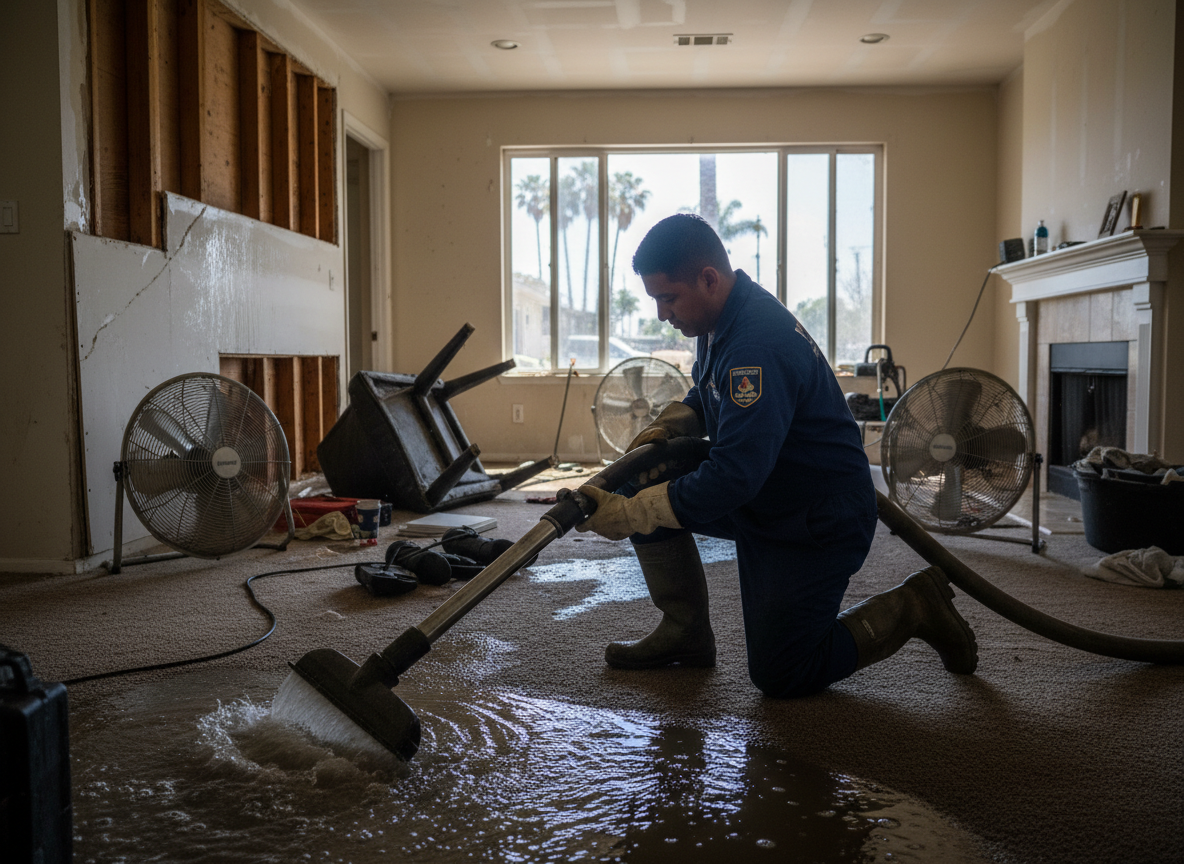
San Pedro's older housing stock, especially pre-1960 stucco and wood-frame homes in Downtown San Pedro and near the USS Iowa, often features slab foundations and limited crawl spaces that trap water after leaks or storms. Marine influence from the nearby Port of Los Angeles keeps relative humidity elevated even in the mild Mediterranean climate, so standard extraction must be paired with targeted dehumidification to prevent hidden mold growth behind baseboards or under flooring. Technicians use truck-mounted units capable of removing standing water from garages and basements common in Rancho Palos Verdes hillside properties where gravity directs runoff toward foundations.
Extraction jobs near Cabrillo Marine Aquarium or Point Fermin Park frequently involve saltwater intrusion from coastal fog or harbor-adjacent flooding, which corrodes metal fixtures faster than fresh water and requires neutralization steps before drying begins. In Harbor City and Wilmington areas, older sewer lines tied to the Port of Los Angeles infrastructure can back up during heavy winter rains, mixing contaminants into residential spaces and demanding containment barriers plus antimicrobial treatment during extraction. Crews document moisture readings at multiple depths in concrete and drywall to meet Los Angeles County building standards before any reconstruction.
Edge cases include multi-unit buildings in Downtown San Pedro where water migrates between units through shared walls, requiring coordinated extraction across floors to avoid shifting moisture into unaffected units. Terrain slopes in Rancho Palos Verdes create pooling against retaining walls, so pumps must be staged at low points while monitoring for soil saturation that could undermine foundations. All work follows local permitting rules for wastewater disposal when large volumes are removed from properties close to the harbor.
Technician insight
In San Pedro the thing that catches most people out with water extraction is how the marine influence from the harbor keeps humidity high long after the rain stops, especially in pre-war homes around Downtown San Pedro where stucco holds moisture against the slab. Homeowners often think once the visible water is gone the job is done, but without staged drying you end up with hidden rot under the flooring near Point Fermin.
Downtown San Pedro Apartment Leak
Water from a second-floor unit migrated through an old shared wall into the unit below near the Port of Los Angeles. Extraction revealed trapped moisture under vinyl flooring and behind baseboards. Crews removed standing water, set up drying zones across both units, and monitored readings for four days until levels stabilized.
How it works
- 1
Initial Assessment
Technicians arrive within hours, map water migration using moisture meters, and identify affected materials in San Pedro homes while checking for hidden paths through older construction.
- 2
Water Removal
Truck-mounted pumps and portable extractors remove standing water from slabs, carpets, and subfloors, with special attention to saltwater near the Port of Los Angeles.
- 3
Drying and Monitoring
Air movers and dehumidifiers are positioned based on the marine humidity typical in San Pedro, with daily readings logged until levels return to safe baselines.
- 4
Final Verification
All surfaces are rechecked, documentation is provided for insurance, and recommendations are given for preventing recurrence in local hillside or harbor-adjacent properties.
Pricing
Cost depends on water volume, access difficulty in older San Pedro homes, and whether saltwater or contaminants are present.