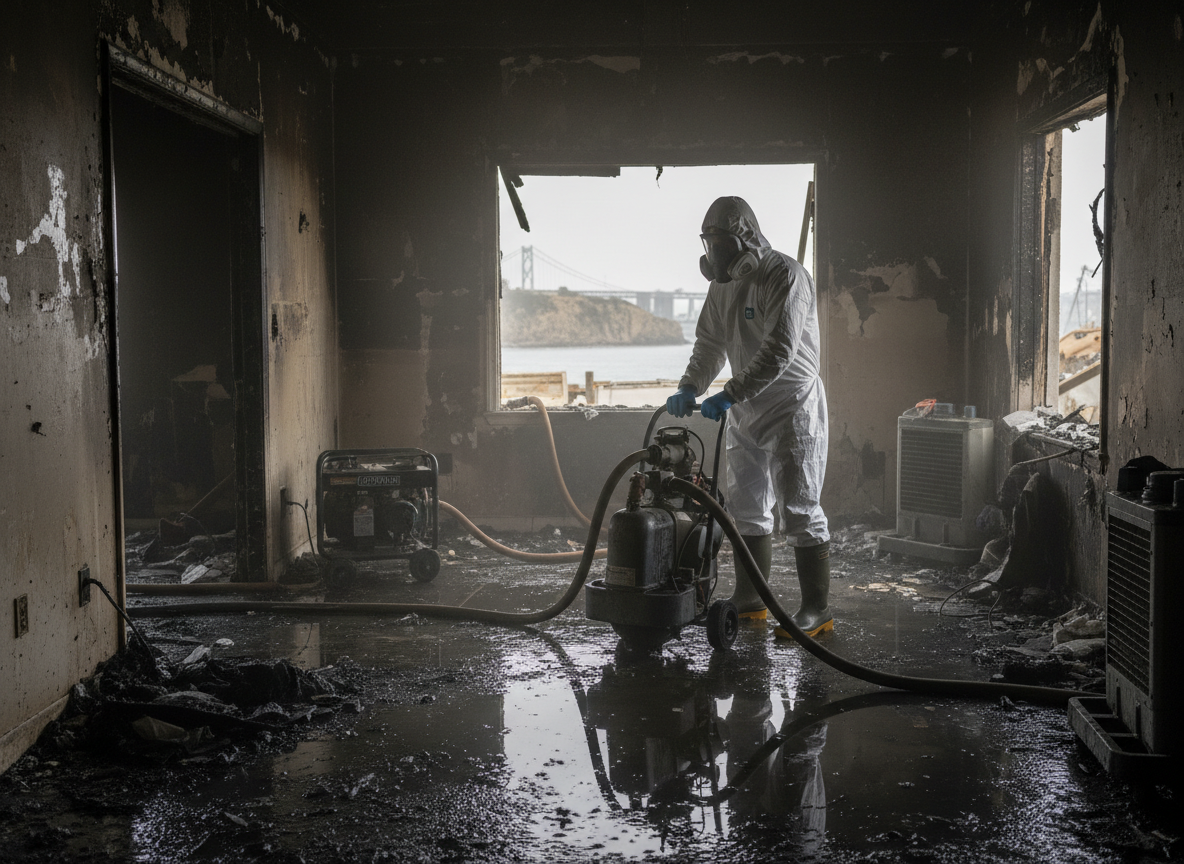
Firefighting water in San Pedro often saturates older wood-framed homes in Downtown San Pedro and Point Fermin, where plaster walls and lath hold moisture long after visible water is gone. The mild Mediterranean climate with marine influence keeps humidity elevated near the Port of Los Angeles, slowing natural evaporation and raising the risk of hidden mold behind cabinets or in crawl spaces. Crews must separate charred materials from water-soaked ones quickly to prevent cross-contamination that spreads soot into previously clean areas.
In neighborhoods like Harbor City and Rancho Palos Verdes, hillside properties drain toward lower streets, so water from upper-floor suppression can travel under flooring and collect against foundations. Los Angeles building codes require documentation of moisture levels before any wall or floor replacement, especially when electrical systems near the USS Iowa waterfront may already be dated. Technicians use infrared imaging to locate pockets that standard meters miss in these layered older structures.
Nearby cities such as Long Beach, Torrance, and Wilmington share similar marine air patterns that extend drying times compared to inland Los Angeles County spots. After a kitchen or electrical fire, crews isolate HVAC systems early to avoid circulating soot-laden moisture through ductwork common in mid-century San Pedro housing stock. Proper sequencing prevents secondary damage that turns a contained incident into full-room rebuilds.
Technician insight
In San Pedro, the thing that catches most people out with water damage remediation after fire is how the marine layer keeps relative humidity high for days after the fire department leaves, especially in the older plaster homes around Downtown San Pedro and near Cabrillo Marine Aquarium. Homeowners often think once the standing water is gone the job is done, but moisture trapped in lath and plaster migrates into framing and underfloor spaces before it ever shows on the surface.
Kitchen Fire Water Migration in Point Fermin
Suppression water from a stovetop fire traveled under cabinets and into the crawl space of a 1940s home near Point Fermin Park. Infrared scans revealed elevated moisture along the foundation that standard checks missed. Extraction and targeted drying prevented mold growth in the subfloor while preserving original hardwood in adjacent rooms.
How it works
- 1
Initial Assessment and Containment
Technicians arrive within hours, map water migration from suppression efforts, and set up barriers to keep soot from spreading into unaffected rooms.
- 2
Water Extraction and Debris Removal
Standing water is removed first, followed by careful separation of fire-damaged materials that could release additional contaminants during drying.
- 3
Drying and Monitoring
Industrial air movers and dehumidifiers run while moisture readings are tracked daily, accounting for the slower evaporation caused by San Pedro's coastal humidity.
- 4
Final Clearance and Documentation
Once levels match pre-loss readings, surfaces are cleaned and a report is prepared for insurance that notes any code-related findings in older Los Angeles County homes.
Pricing
Cost varies with the volume of water introduced during suppression and the age of affected building materials; upfront quotes provided after inspection.